

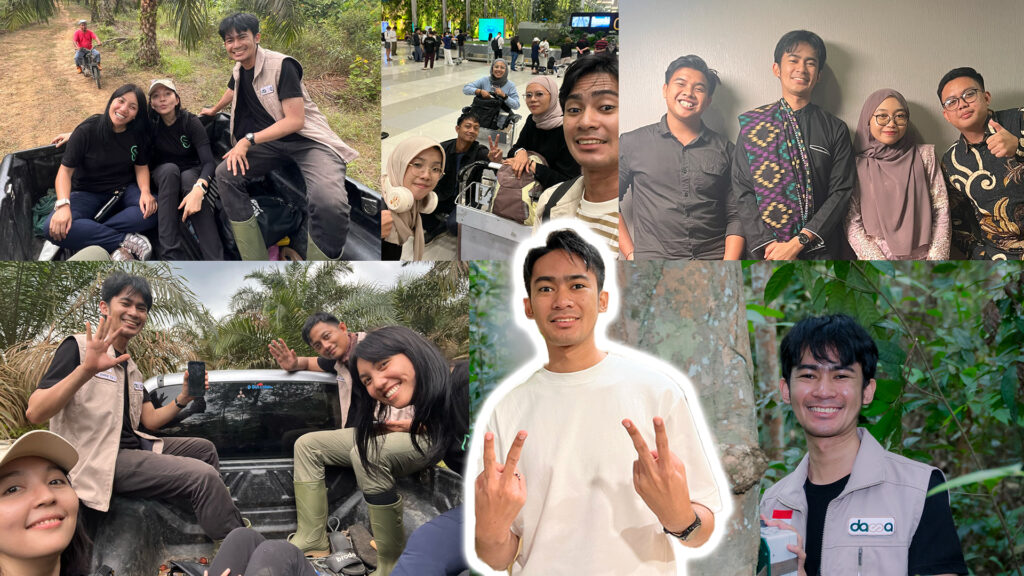
I joined Dassa immediately after graduating from the Forestry Engineering program at Universitas Gadjah Mada. My first day at Dassa was truly enjoyable. In the following days, I had the opportunity to learn and ask questions directly to each team member, while getting to know more about them and their work. During this period, I was encouraged to engage with various tasks at my own pace. Some assignments were operational, while others directly supported project deliverables for clients. Among the various tasks I worked on, my favorite was designing biodiversity observation planning maps and conducting preliminary biodiversity analyses in potential carbon project areas. It felt like being a detective, investigating critical environmental features and ecological risks, while assessing project feasibility. I found myself drawn to projects that not only aim to generate carbon credits but also strive to protect biodiversity and deliver tangible benefits to local communities.
Alongside my internship, I also worked on my final project, which involved studying the level of carbon literacy among forestry students and recent graduates in Indonesia. This experience opened my eyes to the challenges of building human resource capacity in the rapidly developing carbon market sector. It further strengthened my interest in initiatives that combine technical solutions with social aspects, such as education, community engagement, and stakeholder consultation.
Dassa also allowed me to enhance my geospatial analysis skills, an area I had long been interested in but had not yet explored practically. Through various projects, I witnessed firsthand how remote sensing techniques are applied, not only to monitor land use and land cover (LULC) changes and rates of deforestation and degradation, but also to estimate biomass and carbon stocks through parameters such as vegetation cover, tree height, and tree density. Moreover, I recently learned that each forest type in a carbon project has its own method of calculating Verified Carbon Units (VCU), according to Verra standards. Additionally, I discovered how incorporating Climate, Community, and Biodiversity (CCB) Standards can make carbon projects even more meaningful, by ensuring they deliver measurable benefits not only for climate mitigation but also for local communities and biodiversity conservation. I truly enjoyed working in an environment that encouraged continuous learning, critical thinking, and problem solving to deliver impactful and high quality projects.
Now, as my internship comes to a close, I feel deeply grateful for the experience that has broadened both my technical skills and critical thinking approach. This experience has given me a more balanced perspective on the carbon market, not only from an operational or scientific standpoint, but also from an ethical one. Although my initial skepticism toward carbon projects has not completely disappeared, it has evolved into a more mature viewpoint, thanks to firsthand experiences and a deeper understanding of the complexities and dynamics on the ground.
I am now excited to continue building a career in the environmental sector, carrying forward the important lessons I have learned at Dassa, that integrity, scientific rigor, and a community centered approach must go hand in hand to achieve truly meaningful climate action.
Working at Dassa also taught me that every contribution must be driven by dedication and precision, that having the courage to speak the truth based on data and science is crucial, and that the right collaboration can multiply the impact we create. Major change never happens in isolation, it requires collaboration, integrity, and commitment to create a better future.
Written by
Raihan Elfirdausi
Dassa’s Internship Batch 1